Quilting in Appalachia
What is Quilting in Appalachia?
Quilting, Knitting, Crocheting, and Weaving are all popular forms of cloth and textile work that you'll see your grandmother working on for the next grandchild or cousin. All of them have a reason and a history behind them that makes them integral to keeping culture and heritage prevalent in technological times. That history varies depending on where one finds the information. In the Appalachian South quilting history is typically passed from mother to child or grandmother to grandchild. Quilting is how one could gain social standing and information about the community. Quilting is the time in which you learn about your neighbors or your family that you haven't seen for a while. It's something that brings the family together because you are making something for your loved ones. Quilts are typically given as gifts during big life events, such as: births, 18th birthdays, weddings, deaths, and inductions into families. They are very important culturally to many people in the Appalachian South because of how they are made and what they represent.
Quilting, while normally seen as an old people thing, isn't limited to them. Quilting competitions have people of varying ages compete on who makes the best quilt. These competitions are important because they bring together small reclusive communities and it helps its citizens to form closer bonds. These bonds then spread to include said people as family or close friends and very soon they will be getting a quilt, or helping to make one for the next wedding in town.
Quilting, as a practice, can be traced back to medieval times and was brought to popularity in the America's by immigrating Scottish, Irish, and German people. They used their knowledge of quilting and mixed it with the Indigenous people's knowledge of textiles to create what we call Appalachian Quilting today. The mixing of cultures created beautiful patterns and textures when making quilts, as you will see below.
The quilts presented below were chosen for reasons such as: textile context or historical context of quilting in Southern Appalachia, and because they are looking into Southern Appalachia they were chosen from Appalachian related collections or archives. They provide a look at how quilting became something important. The quilts pictured all have varying colorwork, texture, and stitching pattern. They were all made for a reason, either gifts, curiosity, or desire. These quilts truly expound upon the idea that textile work is art and it is hard work.
| TIME | OBJECT | CONTEXT |
|---|---|---|
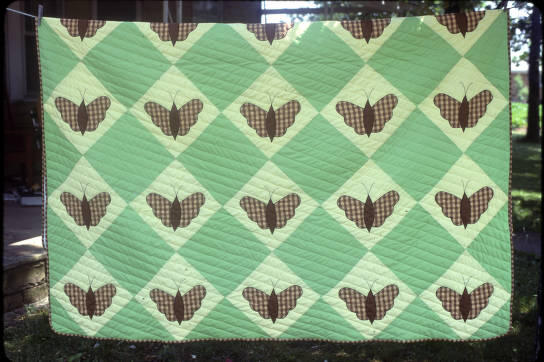
| 1979 June 13 | Butterfly Quilt | This is a Butterfly quilt from the collection of Tennessee State Parks Folklife Collection, 1979-1984. It was photographed in Cumberland County Tennessee, which is almost smack dab in between Knoxville and Nashville. It is a green quilt with brown butterflies hanging on a clothesline. Upon zooming in one can see the butterfly textile is the same as the textile which borders the quilt. This can mean that the back of the quilt is the same color as the butterflies or the quilters who made this quilt went around the edge and sewed in a small strip of fabric in order to make it look more cohesive. |
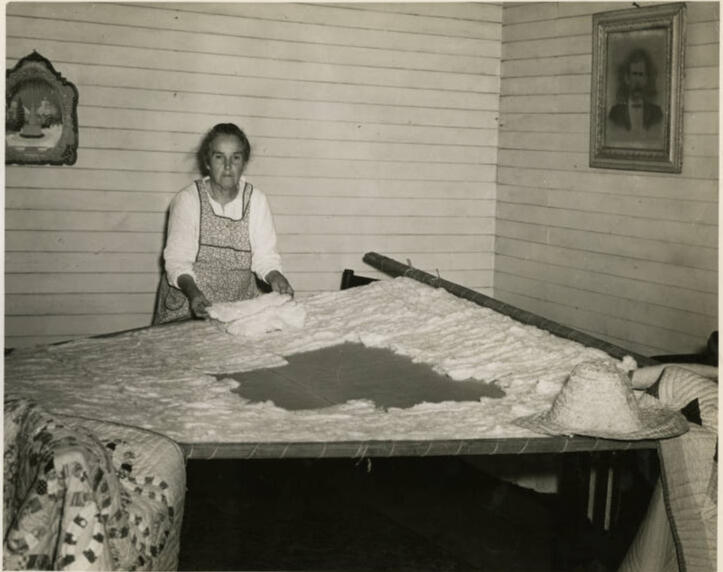
| 1940 September 9 | Nancy Page and Her Quilt | Nancy Page is seen stuffing a quilt with cotton. She has the fabric stretched out in order to properly lay down the cotton. After the cotton is laid she will take the top of the quilt (shown in the bottom left corner) and pull it over the bottom and sew it together. This photograph is held in the collection of Tennessee Department of Conservation Photograph Collection, 1937-1976, and was taken near Crossville Tennessee. The point of creation that she is at with this quilt means that she is about halfway done with making it and will soon have given it away or put into storage for a special occasion. |
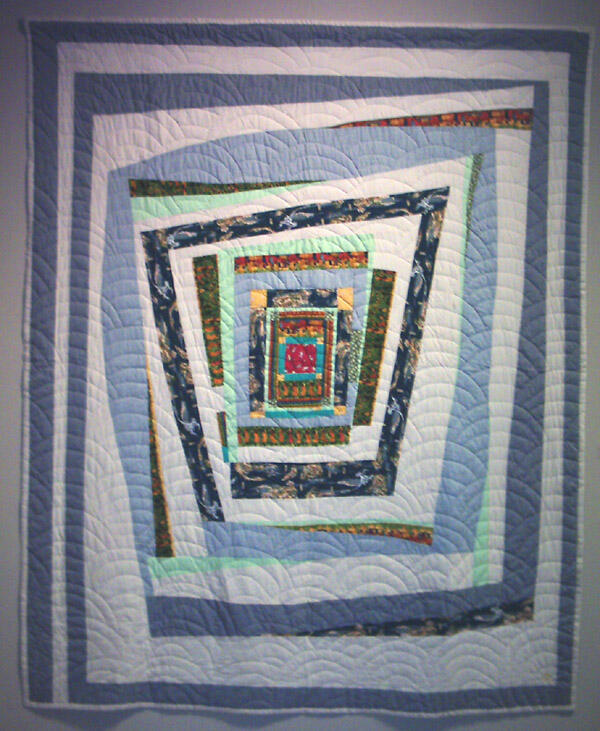
| 2004 | Great White Wave | This quilt is different from the others in that instead of a simple repeating pattern that is commonly seen in quilting, it has an asymmetrical repeating spiral pattern in the color. The actual stitching is done in the shape of waves. This quilt is currently owned by Appalachian State University and they have held it since 2006, even though it was created in 2004 by M. Mueller who lives in Southern Appalachia. He based the quilt off of the idea of tsunamis. Though it is clear that they have been reduced to their utmost basic form when looking at the pattern presented. |
SOURCES
"Butterfly Quilt. Picture. Tennessee Virtual Archive. https://teva.contentdm.oclc.org/digital/collection/p15138coll8/id/4/rec/5
"Nancy Page". Picture. Tennessee Virtual Archive. https://csdt.org/culture/quilting/appalachian.html#:~:text=The%20Appalachian%20version%20of%20quilting,national%20events%20get%20recorded%20too.
“Great White Wave”. Appalachian State University Libraries Digital Collections. https://omeka.library.appstate.edu/items/show/321.